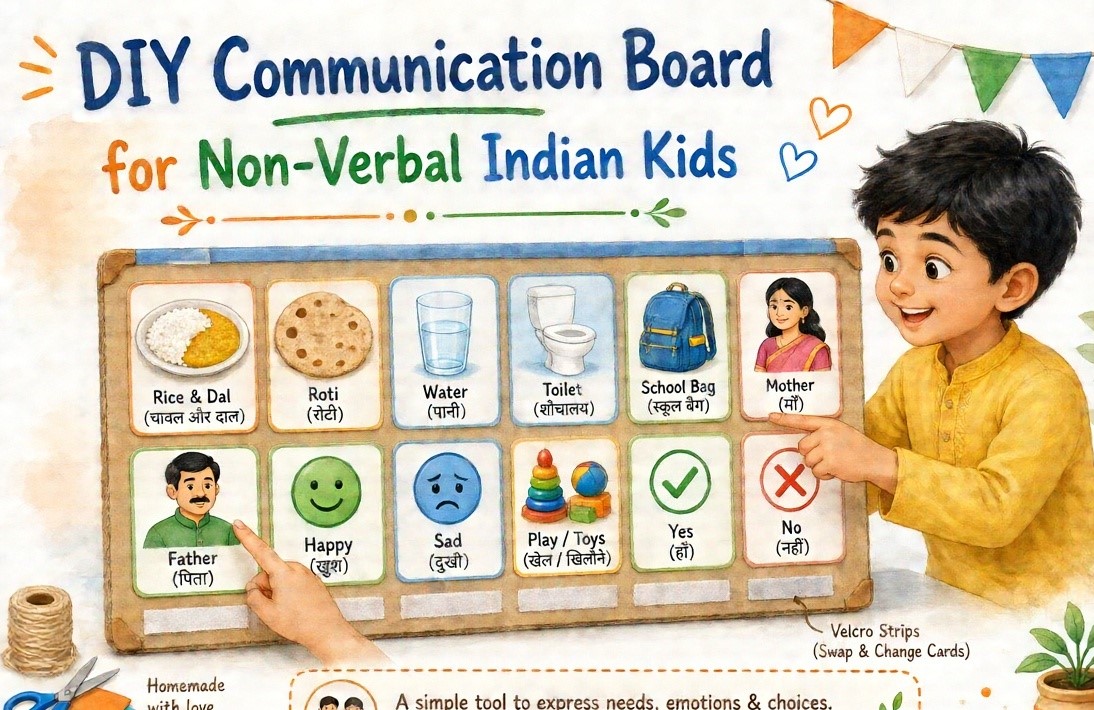
Why a Communication Board Matters for Non‑Verbal Children
For many Indian parents, the silence of a non‑verbal child can feel like a wall that separates love from understanding. A well‑designed communication board turns that wall into a bridge, allowing the child to express wants, feelings, and thoughts without relying on spoken words. Research from the National Institute for the Empowerment of Persons with Disabilities (NIEPD) shows that augmentative and alternative communication (AAC) tools improve language acquisition, reduce frustration‑related behaviours, and increase participation in school and community activities.
Understanding Your Child’s Unique Needs
Before you cut cardboard or download an app, observe your child in everyday situations. Note the gestures they already use, the objects they are drawn to, and the contexts that trigger strong emotions. In a joint‑family home in Chennai, for example, a child may point to a plate during meals but remain silent during a family puja. These observations guide the symbols, colors, and categories you will later place on the board.
Materials You Can Source Locally (and Affordably)
Everyday household items
- Sturdy cardboard or corrugated paper (available at any stationary shop).
- Old magazines, picture books, or printed stickers for visual symbols.
- Non‑toxic glue, double‑sided tape, and a craft knife.
Low‑cost tech options
- Android tablets (often on discount during Diwali sales) with free AAC apps like "LetMeTalk" or "Avaz Lite".
- Reusable whiteboard sheets that can be laminated for durability.
Community resources
- School libraries in Delhi, Bengaluru, and Kolkata often donate picture cards.
- Local NGOs such as Autism Resource Centre (ARC) Mumbai provide printable symbol sets for free.
Step‑by‑Step Construction of a Paper‑Based Board
- Choose the size. A board that fits a dining table (about 30 × 40 cm) works well for daily use; larger boards (A3) are better for therapy sessions.
- Divide into categories. Common sections for Indian families include "Food & Drink", "Bath & Toilet", "School", "Play", and "Feelings". Use bold headings in Hindi, English, or regional language.
- Gather symbols. Cut pictures of roti, dal, mango, water bottle, school bus, cricket bat, smiling face, and a red angry face. Ensure high contrast for children with visual processing challenges.
- Laminate (optional). Run the board through a laminating machine or cover with clear adhesive sheets to withstand spills during Holi or monsoon.
- Attach Velcro or magnetic strips. This lets you swap symbols as your child’s vocabulary expands.
- Test with the child. Sit at a familiar spot, model the use of each symbol, and praise any attempt, however small.
Infusing Indian Culture for Better Engagement
Children respond more readily to symbols that reflect their lived world. Replace generic "apple" icons with a picture of a mango during summer, or add a small image of a diya for the "night" category during festivals. Use regional scripts (Devanagari, Tamil, Bengali) alongside English to reinforce language development and cultural pride.
📎 Related Free Resource · Autism Spectrum
What Is ABA Therapy for Autism? A Simple & Practical Guide for ParentsABA stands for Applied Behaviour Analysis. It is an approach to understanding how behavior and learning are influenced by a perso…
📥 Download FreeIntegrating the Board into Daily Routines
Consistency turns the board into a habit. During breakfast, place the board on the kitchen counter and ask, "What would you like?" When the child points to the cup icon, hand them a glass of milk and verbalise the exchange: "You chose milk. Good job!" Over time, the board becomes a silent partner in every routine—from the morning "school bus" symbol to the evening "story time" picture.
Troubleshooting Common Challenges
Child ignores the board
Introduce the board during low‑stimulus moments (e.g., after a nap) and keep sessions short (2‑3 minutes). Pair the board with a favourite toy as a motivator.
Symbols are not understood
Replace abstract icons with concrete photographs. For a child who loves cricket, use a bat image to represent "play" instead of a generic "toy" icon.
Board gets damaged
Invest in a simple wooden frame or a reusable magnetic board. Many schools in Pune have adopted magnetic boards that can be stored in a cupboard when not in use.
Collaborating with Teachers and Therapists
Share the board with your child’s preschool or special‑needs class. Teachers can reinforce the same symbols in the classroom, creating a seamless bridge between home and school. Many schools under the Right to Education Act (RTE) now include AAC strategies in their inclusive education plans, so a collaborative approach is both supported and encouraged.
Cost‑Effective Sustainability Tips
- Reuse old greeting cards for symbols – Diwali cards often have bright, clear images.
- Organise a "symbol swap" event with other parents in your area; this reduces waste and builds community.
- When upgrading to a digital board, start with a free Android tablet and open‑source AAC apps before investing in premium devices.
Key Takeaways
- Start simple: a cardboard board with locally sourced pictures works as well as expensive devices.
- Tailor symbols to Indian daily life – food, festivals, and regional language boost relevance.
- Consistency is crucial; embed the board in meals, school prep, and bedtime routines.
- Involve extended family members; grandparents often love helping place the right picture.
- Leverage community resources – school libraries, NGOs, and government schemes can provide free materials.
- Upgrade gradually: move from paper to laminated or magnetic boards, then to low‑cost tablets as the child’s communication grows.
Empowering the Journey Ahead
Building a communication board at home is more than a craft project; it is a declaration that every child, regardless of speech ability, deserves to be heard. With a few sheets of cardboard, a handful of pictures, and the love of a supportive family, you can give your child a voice that resonates across the bustling streets of Mumbai, the serene ghats of Varanasi, and the vibrant classrooms of Bengaluru. Remember, each point your child makes on the board is a step toward greater independence, confidence, and connection. Keep experimenting, celebrate every success, and know that you are shaping a future where communication barriers dissolve, one picture at a time.
Free Resources Related to This Post
ABA stands for Applied Behaviour Analysis. It is an approach to understanding how behavio…
📥 Download FreeA printable high-contrast AAC board with 36 core vocabulary words. Can be laminated and us…
📥 Download FreePractical 2-page parent guide with warm illustrations of mom & child. Covers slow talk…
📥 Download FreeYou Might Also Find Helpful
🧩 Autism Corner · 21 Oct 2026
3‑Month Phonics Goal (A‑P) for Mild ASD: IEP Guide for 3‑7 yrA practical, step‑by‑step IEP plan for Indian parents and teachers to teach phonics (A‑P) over…
🧩 Autism Corner · 17 Sep 2026
ABA Therapy for US Parents: What Indian Parents Must KnowDiscover the essential facts about ABA therapy in the United States that Indian parents and educator…
🧩 Autism Corner · 17 Sep 2026
ABA Therapy Global Results: What Indian Parents Need to KnowExplore the worldwide evidence behind Applied Behavior Analysis (ABA) therapy, understand how the da…