Introduction
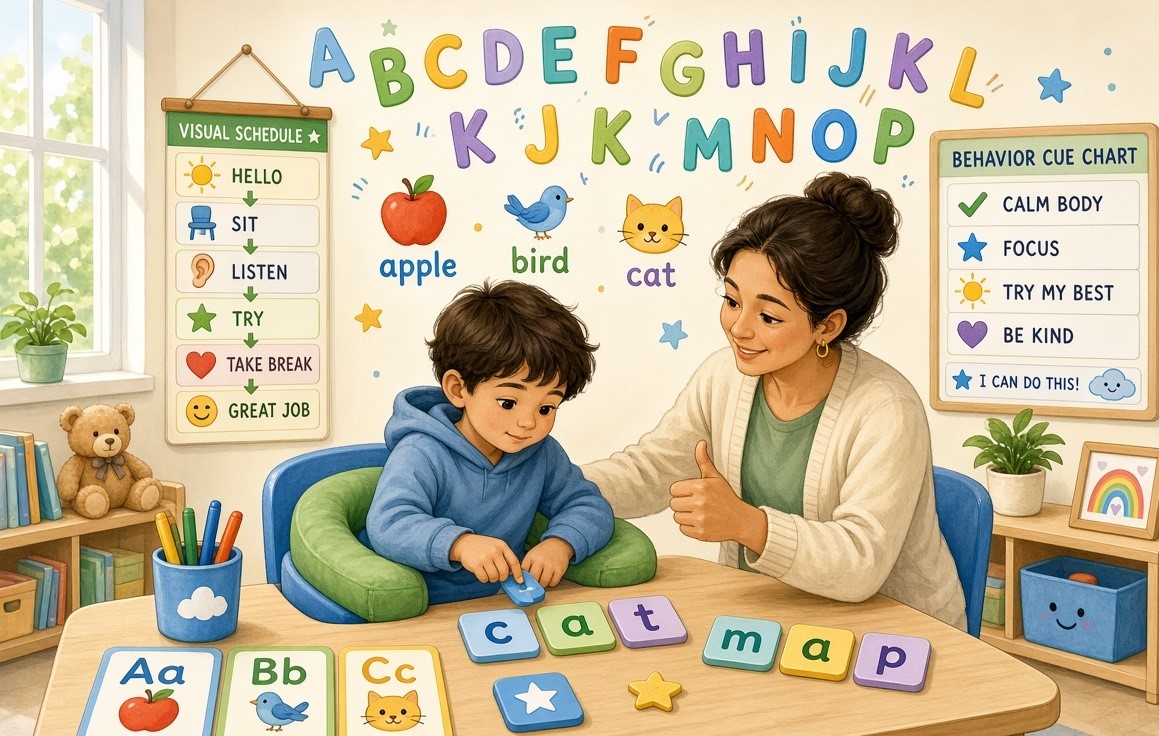
Ravi watches his 5‑year‑old son Arjun struggle with the simple sound of "A" while the classroom buzzes with the rhythm of Hindi rhymes and English chants. The teacher’s gentle cue is met with a sudden flinch, a push‑away of the chair, and a quiet outburst that leaves Ravi feeling helpless. For many Indian parents, the mix of mild autism, unpredictable behaviour, and the practical issue of where a child sits in a bustling classroom can feel like a maze with no clear exit. This post offers a concrete, three‑month phonics goal (A‑P) that fits within an Individualised Education Programme (IEP) for children aged 3‑7 years, while also providing strategies to manage behaviour and optimise seating.
Why a 3‑Month Phonics Goal Matters
Phonics is the foundation of English reading. For children with mild Autism Spectrum Disorder (ASD), early mastery of letter‑sound correspondence can boost confidence, reduce frustration, and open doors to broader academic success. A short, focused three‑month goal is ideal because:
- It aligns with the typical quarterly review cycle used by most Indian schools (e.g., Delhi Public School, Kendriya Vidyalaya, or private Montessori setups).
- It gives teachers and therapists a clear window to collect data, adjust instruction, and celebrate tangible progress.
- It prevents the overwhelm that can come from long‑term, vague objectives, especially when behaviour and sensory needs are also being addressed.
Understanding the 3‑7 yr IEP Context in India
Indian special education operates within a blend of government mandates (like the Rights of Persons with Disabilities Act, 2016) and school‑level policies. Most schools follow the National Curriculum Framework (NCF) for early literacy, but the implementation varies widely across metros like Mumbai, Bengaluru, and tier‑2 towns such as Jaipur or Coimbatore. When drafting an IEP for a child with mild ASD, consider these contextual factors:
📎 Related Free Resource · Speech & Language
Best Home Speech Therapy Activities for Autism | Parent GuidePractical 2-page parent guide with warm illustrations of mom & child. Covers slow talking, picture cards (water, food, toilet)…
📥 Download Free- Assessment tools: Use the Indian Scale for Assessment of Autism (ISAA) for baseline, then supplement with phonics screening tools like the Phonics Screening Check used in many English‑medium schools.
- Resource availability: Urban schools may have speech‑language pathologists (SLPs) on staff, while rural settings might rely on visiting therapists or NGOs like Special Olympics India and Akshara Foundation.
- Family dynamics: Joint families often share caregiving responsibilities; involve grandparents in reinforcement activities, especially during festivals when routines shift.
- Government schemes: The Inclusive Education for Disabled Children (IEDC) scheme can fund assistive devices, while the Sarva Shiksha Abhiyan provides teacher training grants.
Designing the 3‑Month Phonics Goal (A‑P)
Goal Statement
By the end of 12 weeks, Arjun will accurately produce the phonemic sounds /æ/ (A), /p/ (P) and blend them to read the word “ap” in 4 out of 5 opportunities, as measured by teacher‑recorded data sheets.
Rationale
Choosing “A‑P” is strategic: the vowel /æ/ is often a sensory trigger (the mouth opens wide) and the consonant /p/ offers a tactile‑bilabial cue that can be reinforced with hand‑on activities. Mastery of these two sounds lays groundwork for other vowel‑consonant pairs (e.g., “at”, “am”, “an”).
Instructional Steps
- Sensory Warm‑up (5 min): Use a soft “pillow‑pop” game where the child squeezes a small pillow while saying /p/. This prepares the oral‑motor system and satisfies sensory‑seeking needs.
- Visual Cue Introduction (5 min): Show a large flashcard with the letter “A” in bright red, paired with a picture of an apple. Pair the visual with a consistent hand sign (thumb‑up for “A”).
- Auditory Modeling (3 min): Teacher/model the /æ/ sound slowly, exaggerating mouth shape. Record the sound on a tablet for playback.
- Multisensory Production (7 min): Child repeats the sound while tracing the letter “A” on sandpaper letters, then pops the pillow to reinforce /p/.
- Blending Practice (10 min): Use a “sound train” board: place “A” and “P” cars on a track, ask the child to say each sound, then push both together and say “ap”.
- Contextual Application (5 min): Show an image of an “apple” and ask, “What do we call this?” Encourage the child to respond with “ap‑”. Provide a picture‑sentence strip: “I see an ap‑.”
Frequency & Duration
Implement the mini‑lesson daily for 15‑20 minutes within the literacy block. For children with attention challenges, break the session into two 10‑minute chunks (morning and post‑recess). Consistency is key; even on festival days like Diwali, allocate a brief “phonics corner” during the evening family gathering.
Progress Monitoring
Use a simple ABC Data Sheet (Antecedent‑Behaviour‑Consequence) combined with a phonics accuracy log:
- Record the date, prompt type (visual, auditory, tactile), and the child’s response (correct, self‑correct, error).
- Calculate a weekly accuracy rate (e.g., 4/5 correct = 80%).
- Plot the data on a line graph to share with parents during the quarterly IEP meeting.
Addressing Behaviour Challenges Within the Phonics Block
Behavioural bursts often stem from sensory overload, communication frustration, or a lack of clear expectations. The following strategies dovetail with the phonics routine:
Predictable Structure
Start each session with a visual schedule (e.g., a picture‑card sequence: “Sit → Warm‑up → Flashcard → Play → Review”). Children with ASD thrive on predictability, reducing the likelihood of escape‑behaviour.
Positive Behaviour Support (PBS)
Identify a specific, attainable reinforcement that aligns with Indian cultural values. For example, a “sticker‑star” that can be exchanged for a favourite snack (e.g., a small piece of jaggery) or extra time on a favourite tablet app during the evening. Reinforce the target behaviour (staying seated, attempting the sound) immediately.
Functional Communication
If Arjun becomes frustrated, provide a simple “help” card with the symbol “❓”. Teach him to hand the card to the teacher instead of shouting. This reduces escalation and teaches an alternative communication pathway.
Crisis Prevention
Maintain a calm, low‑stimulus corner in the classroom (a small tent with soft lighting). If a behavioural episode escalates, gently guide the child there for a brief sensory break before resuming the lesson.
Seating Strategies for Optimal Learning
Seating is more than a physical location; it influences sensory input, peer interaction, and the child’s ability to focus. Consider the following evidence‑based approaches tailored to Indian classrooms:
Proximity to the Teacher
Place the child within 2–3 rows of the teacher’s desk. This allows the teacher to offer immediate prompts, visual cues, and quick redirection without drawing undue attention from peers.
Flexible Seating Options
Offer a choice of seating: a standard chair with a cushion, a wobble stool, or a low‑back “sensory” chair with a gentle rocking motion. Research from the University of Delhi indicates that mild vestibular input can improve attention in children with ASD.
Visual Boundaries
Use a thin, non‑intrusive floor mat (e.g., a colored rug) to demarcate the child’s work area. The mat can be decorated with familiar motifs (e.g., a peacock or a rangoli pattern) to create a culturally resonant cue.
Peer Buddy System
Pair the child with a supportive peer (often a classmate who enjoys helping) who can model appropriate posture and hand‑over‑hand assistance during the phonics activity. This also promotes social inclusion.
Minimise Distractions
Position the seat away from high‑traffic zones such as the door, window, or loud playground view. In schools with open‑plan layouts (common in many private preschools), use low partitions or plants to create a subtle visual barrier.
Collaborating with Parents and Therapists
Effective IEP implementation is a team effort. Here’s a roadmap for regular communication:
- Weekly Home‑School Log: A one‑page notebook (or WhatsApp voice note) where teachers record the child’s phonics successes and any behavioural incidents. Parents can add observations from home.
- Monthly Review Call: Schedule a 15‑minute video call (via Zoom or Google Meet) with the SLP and a behavioural therapist to align strategies.
- Parent Training Workshops: Organise a quarterly session (often hosted by NGOs in cities like Hyderabad or Pune) where parents learn to use the same flashcards and pillow‑pop activity at home.
- Data Sharing Platform: Use a free tool like Google Sheets with restricted access, where all stakeholders can view progress graphs in real time.
Adapting the Goal for Different Indian Settings
While the core phonics target remains "A‑P," you can customise the materials to reflect regional languages and festivals:
- Marathi schools (Pune): Replace the apple picture with a "अपली" (apple) illustration that includes the Marathi script underneath.
- Kerala Malayalam medium schools: Use the word "അപ്പ" (app) as a transliteration exercise, linking English phonics to the native script.
- During festivals: Incorporate themed visuals—e.g., a lantern for "ap‑" during Diwali, or a kite for "ap‑" during Makar Sankranti—to maintain engagement.
Key Takeaways
- Set a clear, three‑month phonics goal (A‑P) that aligns with quarterly IEP reviews used across Indian schools.
- Use multisensory steps—visual flashcards, tactile pillow‑pop, auditory modeling—to meet the sensory needs of children with mild ASD.
- Integrate Positive Behaviour Support, functional communication cards, and a calm‑down corner to manage behaviour without disrupting learning.
- Choose seating that offers proximity, sensory input options, and visual boundaries, and consider cultural décor to create a welcoming space.
- Maintain a strong home‑school‑therapist loop through weekly logs, monthly calls, and shared data platforms.
Conclusion
Teaching the sounds "A" and "P" may seem modest, but for a child like Arjun it can unlock a world of confidence, communication, and academic progress. By embedding the phonics goal within a compassionate IEP framework—one that respects behavioural realities, seating comfort, and the rich tapestry of Indian family life—parents and educators can turn daily challenges into measurable victories. Remember, every correct sound is a step forward, and every supportive gesture from a teacher, therapist, or grandparent builds the bridge to a brighter, more inclusive future for neurodivergent learners in India.
Free Resources Related to This Post
You Might Also Find Helpful
🧩 Autism Corner · 17 Sep 2026
ABA Therapy for US Parents: What Indian Parents Must KnowDiscover the essential facts about ABA therapy in the United States that Indian parents and educator…
🧩 Autism Corner · 17 Sep 2026
ABA Therapy Global Results: What Indian Parents Need to KnowExplore the worldwide evidence behind Applied Behavior Analysis (ABA) therapy, understand how the da…

🧩 Autism Corner · 17 Sep 2026
Weighted Blankets & Sensory Tools for Indian Kids: Do They Work & Where to Buy?Discover whether weighted blankets and other sensory tools truly help neurodivergent children in Ind…