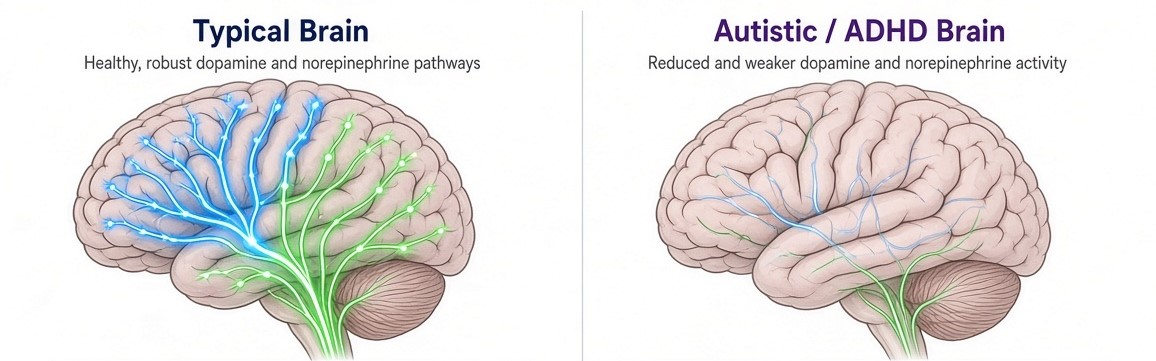
REASONS OF HYPERACTIVITY IN AN
AUTISTIC/ ADHD CHILD
Have you ever
thought about what exactly happens with an autistic or ADHD child when they
become hyper or uncontrollable?
There is only a
biological reason that compels their body to move like that and it is inbuilt.
That is why it is very, very important to understand the biology of our little
needy children.
📎 Related Free Resource · ADHD
ADHD Homework Helper PlannerA structured homework planner with built-in break reminders, priority boxes, and a "done!" celebration section.…
📥 Download FreeLet us talk about
what happens inside the brain:
- Prefrontal
Cortex
– This part is responsible for attention, impulse control and planning. In
these children it is often underactive.

Solution for Point 1 (Prefrontal Cortex)
Get a proper assessment done. After that plan occupational therapy and sports.
Preferably swimming, gymnastics and skating. These activities channelize the
energy level, increase focus, improve sitting tolerance and also develop
hand-eye coordination.
- Key
Neurotransmitters
– Dopamine and norepinephrine are lower or not used efficiently in certain
brain areas.

Solution
for Point 2 (Dopamine & Norepinephrine)
Medical and pharmacological evaluation is important. Consult a developmental
paediatrician, child psychiatrist or paediatric neurologist.
Also focus on:
- Medications
for co-occurring ADHD features (if required)
- Ruling out
other co-existing conditions
- Occupational
Therapy & Sensory Integration
- Executive
Function Coaching / Special Education
- Lifestyle
and environmental supports
- High-interest
special-topic reinforcement
- Physical
movement and play
- Structured
routines with visual schedules
3. Weaker Braking System – The brain’s “braking system” is
weaker, so the child cannot easily stop or control movement and impulses.

Solution
for Point 3 (Weaker Braking System)
- Create
environmental brakes (change the setup)
- Give clear
communication and cues – tell them exactly what to do
- Use body and
sensory regulation to calm the nervous system
- Rhythmic
activities such as swinging, rocking or marching to a beat help train
motor rhythm and inhibition control
- Over-active
Motor Areas
– Motor areas of the brain remain over-active. This creates a constant
need to move.

Solution
for Point 4 (Motor Over-Activity)
- Provide
wiggle room (fidget devices)
- Give heavy
work input
- Schedule
movement snacking (short movement breaks)
- Sensory
Processing Differences
– There are differences in sensory processing areas of the brain,
especially the thalamus and sensory cortex.

Solution for Point 5 (Sensory Processing
Differences)
- Occupational
Therapy and Sensory Integration
- Use sensory
tools and create a supportive environment
- Controlled
deep pressure
- Create
predictable sensory spaces
- Glutamate–GABA
Imbalance
– There is an imbalance between excitatory (glutamate) and inhibitory
(GABA) signals. Because of this the brain can become over-excited.

Solution for Point 6 (Glutamate–GABA
Imbalance)
- Daily deep
pressure and rhythm activities
- Magnesium
and protein-rich foods
- Low-sensory
evening wind-down routine
- Physician-guided
supplements (only after proper advice)
Conclusion
I would like to say to every parent – if these methods are strictly followed by
you, you will definitely see visible results. Every small action, response and
reaction of the child depends upon your consistent efforts.
Understanding the
biology helps us respond with patience instead of frustration. When we work
with the child’s brain instead of against it, real change begins.
For More
Information Stay Connected and Leave your message in our community area in our
website https://www.specialeducation24.com/forum where parents can leave their
question and I would be happy to help you.
Special Educator
Ms. Sarita Rai
9899878180
Free Resources Related to This Post
You Might Also Find Helpful

👨👧👦 Parent Tips · 01 Sep 2026
Simple Home Activities That Help Language Development in Children with Autism & Developmental DelaysChildren with autism or developmental delays often improve in behaviour and social skills with thera…

👨👧👦 Parent Tips · 31 Aug 2026
Adulthood with Autism: Strategies for Rigidity, Aggression, and ResistanceAdulthood with Autism: Strategies for Rigidity, Aggression, and Resistance…
👨👧👦 Parent Tips · 06 Jul 2026
ADHD and ASD TogetherMany Indian parents wonder if their child can have both ADHD and ASD. This comprehensive guide explo…