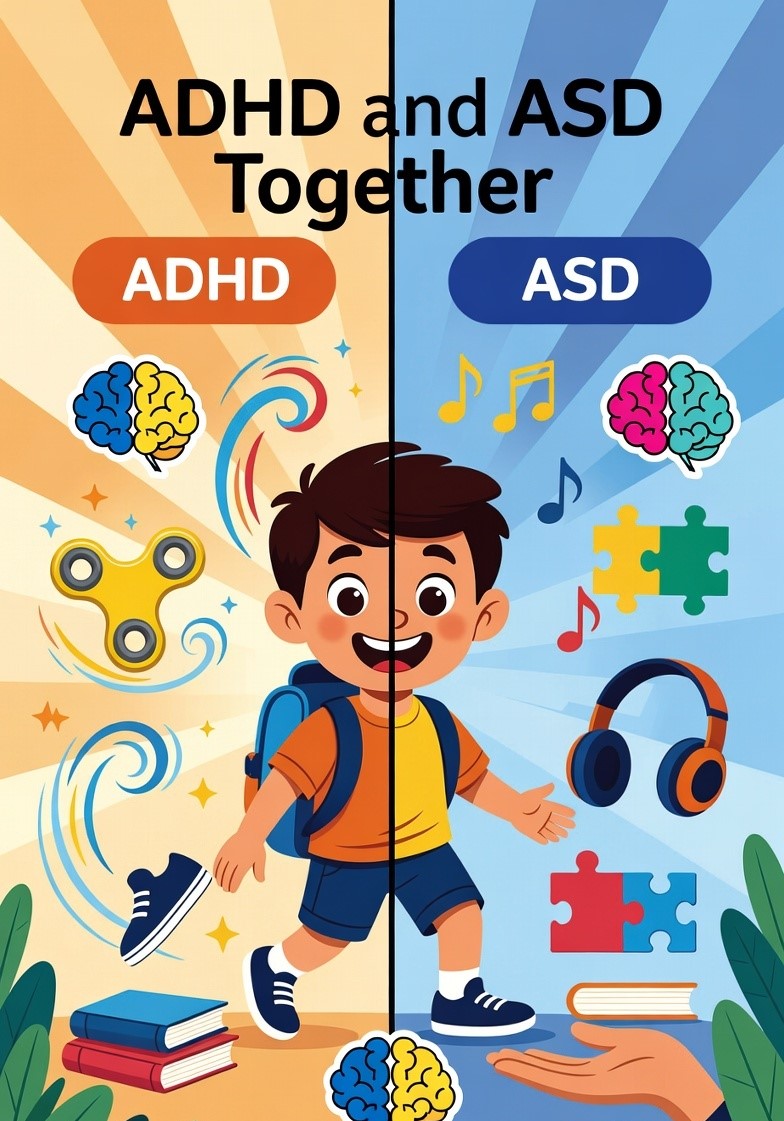
Introduction to ADHD and ASD
As an Indian parent, you may have noticed that your child exhibits symptoms of both ADHD and ASD. Perhaps your child has difficulty paying attention in class, but also struggles with social interactions and repetitive behaviors. You're not alone - many parents in India are navigating the complexities of neurodivergent children. With the increasing awareness of ADHD and ASD, it's essential to understand how these conditions can co-occur in one child.
What are ADHD and ASD?
ADHD (Attention Deficit Hyperactivity Disorder) is a neurodevelopmental disorder characterized by symptoms of inattention, hyperactivity, and impulsivity. ASD (Autism Spectrum Disorder), on the other hand, is a neurodevelopmental disorder that affects social interaction, communication, and behavior. While they are distinct conditions, research suggests that they can co-occur in approximately 30-80% of cases.
Symptoms of ADHD and ASD in Children
Identifying the symptoms of ADHD and ASD in children can be challenging, especially in the Indian context where these conditions are often stigmatized or misunderstood. Common symptoms of ADHD include:
📎 Related Free Resource · Autism Spectrum
What Is ABA Therapy for Autism? A Simple & Practical Guide for ParentsABA stands for Applied Behaviour Analysis. It is an approach to understanding how behavior and learning are influenced by a perso…
📥 Download Free- Inattention: difficulty paying attention to details, following instructions, or completing tasks
- Hyperactivity: fidgeting, restlessness, or an inability to stay still
- Impulsivity: interrupting others, blurting out answers, or acting without thinking
Common symptoms of ASD include:
- Social interaction difficulties: struggling to initiate or maintain conversations, understanding nonverbal cues, or developing and maintaining relationships
- Communication difficulties: delayed or absent language development, struggling to understand tone of voice or sarcasm, or repetitive language patterns
- Repetitive behaviors: hand flapping, body rocking, or an intense interest in specific topics or activities
Navigating the Indian Education System
The Indian education system can be challenging for neurodivergent children, with large class sizes, strict academic expectations, and limited resources for special education. However, there are government schemes and initiatives that aim to support children with disabilities, such as the Right to Education (RTE) Act and the Sarva Shiksha Abhiyan (SSA) program. Parents can also explore private schools and institutions that cater to special needs, such as the National Institute of Mental Health and Neuro Sciences (NIMHANS) in Bangalore or the Action for Autism (AFA) in Delhi.
Diagnosis and Assessment
Diagnosing ADHD and ASD in children requires a comprehensive assessment by a multidisciplinary team of professionals, including psychologists, psychiatrists, and special educators. In India, parents can consult with experts at government hospitals, private clinics, or non-profit organizations that specialize in autism and ADHD. A thorough diagnosis can help identify the co-occurring conditions and inform the development of an individualized education plan (IEP).
Supporting Your Child's Unique Needs
As a parent, it's essential to create a supportive environment that caters to your child's unique needs. This can include:
- Developing a daily routine that incorporates structure and flexibility
- Using visual aids, such as pictures or schedules, to facilitate communication
- Encouraging social interactions through playdates, therapy sessions, or support groups
- Providing opportunities for physical activity and exercise to manage hyperactivity
- Seeking out resources and support from local communities, online forums, or counseling services
Key Takeaways
- ADHD and ASD can co-occur in one child, and it's essential to understand the symptoms and challenges associated with both conditions
- Early diagnosis and assessment are critical in developing an effective individualized education plan (IEP) for your child
- The Indian education system has its challenges, but there are government schemes and initiatives that support children with disabilities
- Creating a supportive environment that caters to your child's unique needs is crucial in empowering them to thrive
- Seeking out resources and support from local communities, online forums, or counseling services can help you navigate the journey of supporting a neurodivergent child
Conclusion
As an Indian parent of a neurodivergent child, you are not alone. With the right support, resources, and understanding, you can empower your child to thrive and reach their full potential. Remember that every child is unique, and it's essential to focus on their strengths and abilities rather than their challenges. By embracing their neurodiversity and celebrating their individuality, you can create a brighter future for your child and help them navigate the complexities of ADHD and ASD in India.
Free Resources Related to This Post
ABA stands for Applied Behaviour Analysis. It is an approach to understanding how behavio…
📥 Download FreeA structured homework planner with built-in break reminders, priority boxes, and a "done!"…
📥 Download FreeLooking for a balanced approach to support a child with autism? This resource shares a pra…
📥 Download FreeA practical, parent-friendly guide with clear academic goals for phonics, numbers, Hindi V…
📥 Download FreeYou Might Also Find Helpful

👨👧👦 Parent Tips · 22 Sep 2026
मेरी माँ ने कैसे मेरी ऑटिज़्म से लड़ाई में मेरी मदद की: प्यार, थेरेपी और जीत की एक भावनात्मक सच्ची कहानी | सौरभमेरा नाम सौरभ है। जब मैं 9 साल का था, दु�…

👨👧👦 Parent Tips · 22 Sep 2026
How My Mom Helped Me Overcome Autism: An Emotional True Story of Love, Therapy & Triumph | Danniel LioWhen I was 9, the world felt like a puzzle missing half its pieces. I spoke differently. I behaved …
👨👧👦 Parent Tips · 06 Sep 2026
How to Manage ADHD in a 3-Year-Old at Home Without Medication: A Complete Daily Plan for ParentsPractical daily plan to manage ADHD hyperactivity in a 3-year-old at home without medication. Simple…