Being a parent of an adult on the autism spectrum is an exhausting, deeply personal, and often misunderstood journey. When your child turns 18, the support systems often drop off, but the challenges don't pause—especially when sensory needs went unmet or misunderstood in their younger years.
Years of sensory
overload or unmet needs build up. When an adult can’t process the world around
them comfortably, it almost always shows up as rigid behaviour, stubborn
resistance, or explosive meltdowns. The good news? It is never too late to
start meeting those sensory needs.
Here is a
practical, heart-first look at how to rebuild connection, reduce rigidity, and
help your adult child find balance through daily movement and real home
engagement.
📎 Related Free Resource · Autism Spectrum
What Is ABA Therapy for Autism? A Simple & Practical Guide for ParentsABA stands for Applied Behaviour Analysis. It is an approach to understanding how behavior and learning are influenced by a perso…
📥 Download FreeStep 1: Head Outside (Movement as a Sensory
Reset)
You can't lecture
someone out of sensory overload or rigid thinking, but physical movement can
work wonders on the nervous system. The key is meeting them where they are
right now without overloading them with strict rules.
- Start with
what they actually love: If your son or daughter loves cricket,
football, or cycling, start there. Don't worry about official rules or
perfect technique at first. If cricket means just hitting the ball as hard
as they can, let them do it.
- Keep tasks
ridiculously simple initially: If kicking a soccer ball feels like a
chore to them, just pass it back and forth from two feet away. The goal
isn't athletic performance; it's building interest, comfort, and positive
association.
- Build up
gradually:
As their confidence grows, you can slowly introduce regular play, longer
cycling routes, or actual game structures.
- The hidden
benefit (Weight & Energy Management): Regular
outdoor activity helps manage weight and burns off bottled-up physical
nervous energy, which naturally lowers evening anxiety and rigidity.
Step 2: Bring Them Into the Daily Rhythm of
the Home
Instead of
treating your adult child like a guest or trying to force abstract "study
time," make them an essential part of keeping the house running. Working
with their hands in real, tactile ways provides heavy-work sensory input
(proprioceptive feedback), which calms an anxious brain.
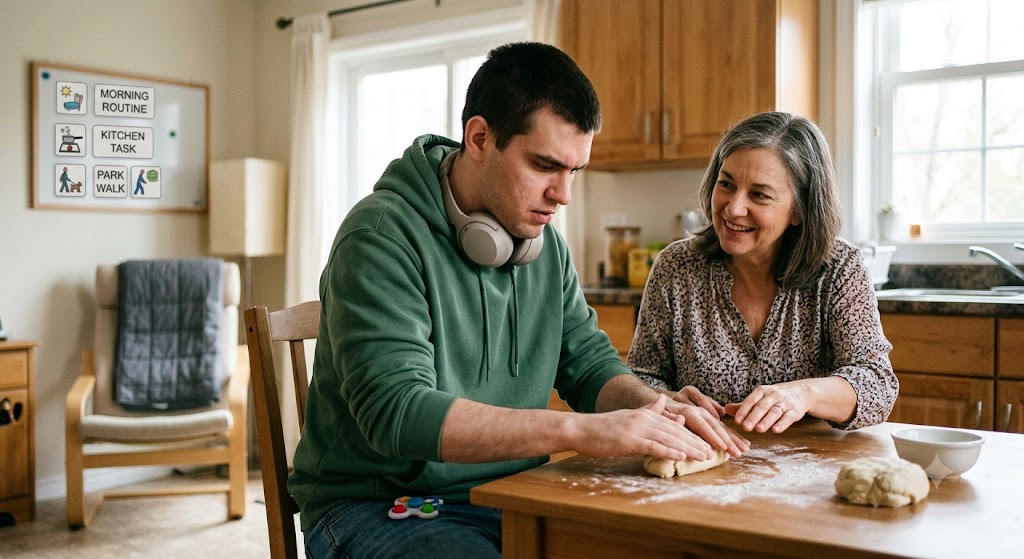
Involve them in
everyday household tasks from start to finish:
- In the
Kitchen:
Have them wash raw vegetables under running water (great tactile sensory
input), help roll or knead flour dough (amazing deep-pressure sensory work
for hands), or set the table.
- Mealtime
Connections:
Ask them to help serve food to the rest of the family. It subtlely builds
social awareness, empathy, and a sense of contribution.
- Nighttime
Reset:
Make it a routine for them to help clear the kitchen or finish up chores
after dinner.
Why This Approach Actually Works
When you involve
an adult child in these structured, physical, hands-on tasks, three big things
start to shift:
- Coordination
& Body Awareness:
Handling sports equipment, kneading dough, and carrying dishes train the
brain and body to work together smoothly.
- Emotional
Connection:
Working alongside a parent—without being nagged or lectured—builds
trust. Shared tasks create quiet bonding moments that don't force
uncomfortable eye contact or intense conversation.
- Breaking the
Rigidity Loop:
Defiance and rigidity usually happen when someone feels bored,
overwhelmed, or powerless. Channelling their energy into useful,
predictable, daily activities gives their day structure and a sense of
purpose.
A Note for Exhausted Parents
Progress with an
adult on the spectrum isn't a straight line. Some days, washing a single
vegetable will be a victory; other days, they might refuse to step outside.
That is completely normal.
Be patient with them, but more importantly, be patient with you. You are shifting patterns that took years to form. Focus on small, daily wins, keep the atmosphere light, and remember that connection always matters more than compliance.
Free Resources Related to This Post
ABA stands for Applied Behaviour Analysis. It is an approach to understanding how behavio…
📥 Download FreeLooking for a balanced approach to support a child with autism? This resource shares a pra…
📥 Download FreeA practical, parent-friendly guide with clear academic goals for phonics, numbers, Hindi V…
📥 Download FreePlan the future of your autistic child with confidence. Learn about legal guardianship, Na…
📥 Download FreeYou Might Also Find Helpful

👨👧👦 Parent Tips · 22 Sep 2026
मेरी माँ ने कैसे मेरी ऑटिज़्म से लड़ाई में मेरी मदद की: प्यार, थेरेपी और जीत की एक भावनात्मक सच्ची कहानी | सौरभमेरा नाम सौरभ है। जब मैं 9 साल का था, दु�…

👨👧👦 Parent Tips · 22 Sep 2026
How My Mom Helped Me Overcome Autism: An Emotional True Story of Love, Therapy & Triumph | Danniel LioWhen I was 9, the world felt like a puzzle missing half its pieces. I spoke differently. I behaved …

👨👧👦 Parent Tips · 06 Sep 2026
How to Manage ADHD in a 3-Year-Old at Home Without Medication: A Complete Daily Plan for ParentsPractical daily plan to manage ADHD hyperactivity in a 3-year-old at home without medication. Simple…