Introduction to Setting Boundaries
As an Indian parent of a neurodivergent child, you're likely no stranger to the mix of emotions that come with navigating family gatherings and festivals like Diwali or Holi. While your relatives may be well-intentioned, their advice or comments about your child's behavior, diet, or education can be overwhelming and sometimes, hurtful. You may have experienced a situation where a relative has suggested that your child's autism is a result of bad parenting or that their ADHD can be cured with a strict diet. Such comments can be not only unhelpful but also damaging to your child's self-esteem and your relationship with them.
Understanding the Importance of Boundary Setting
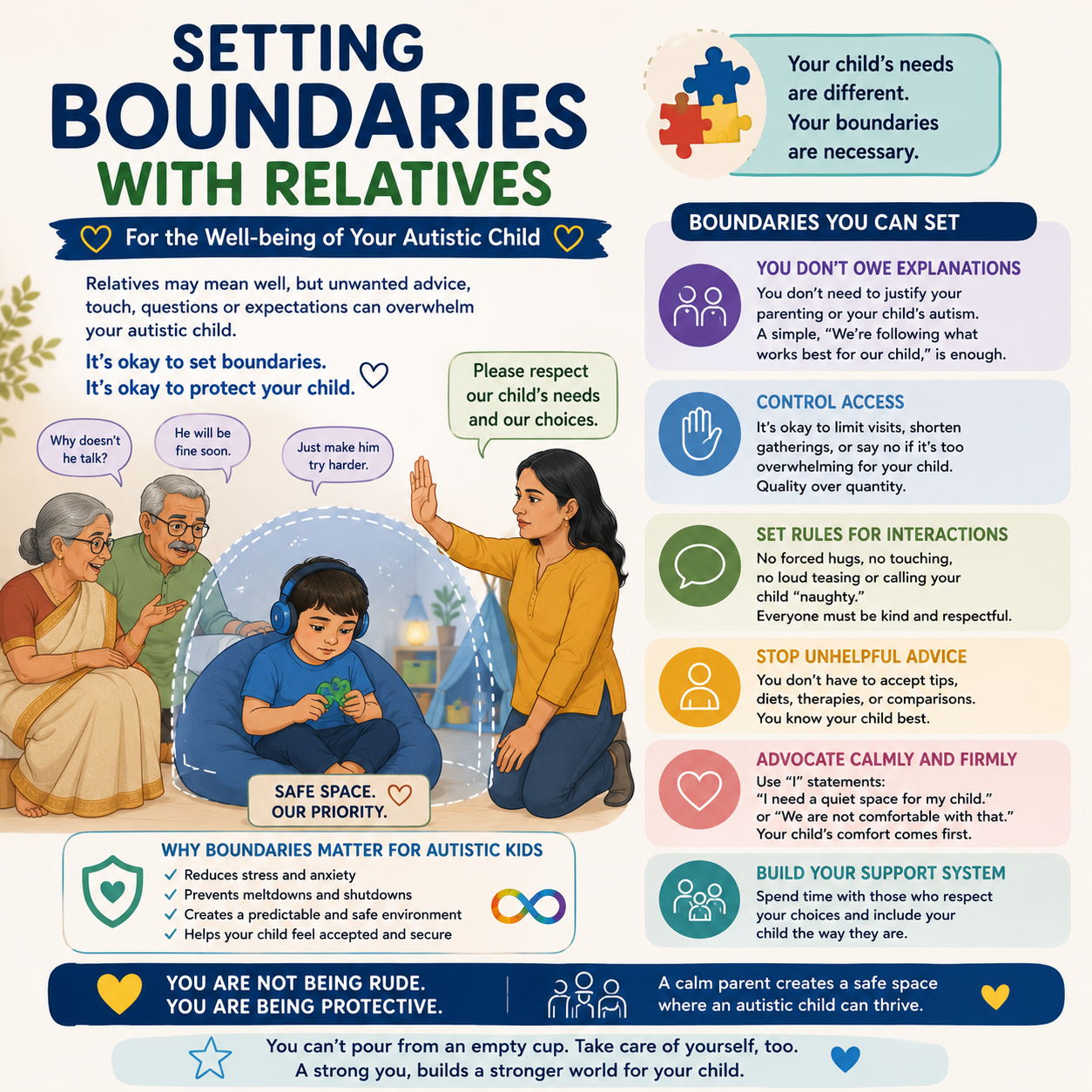
Setting boundaries with relatives is essential for maintaining your emotional well-being and ensuring that your child receives the support and acceptance they need. When you set clear boundaries, you communicate your values, priorities, and expectations to your relatives, helping them understand what is and isn't acceptable when it comes to your child. This, in turn, helps to reduce conflicts and misunderstandings, creating a more positive and supportive environment for your child to thrive.
Communicating Your Child's Needs
Effective communication is key to setting boundaries with relatives. It's essential to be clear, direct, and respectful when explaining your child's needs and how they can support them. Consider the following tips when communicating with your relatives:
📎 Related Free Resource · Autism Spectrum
What Is ABA Therapy for Autism? A Simple & Practical Guide for ParentsABA stands for Applied Behaviour Analysis. It is an approach to understanding how behavior and learning are influenced by a perso…
📥 Download Free- Be open and honest about your child's diagnosis, strengths, and challenges.
- Explain how their behavior or comments may be impacting your child and your relationship with them.
- Set clear expectations for how you would like them to interact with your child.
- Offer suggestions for how they can support your child, such as attending therapy sessions or helping with daily routines.
Navigating Joint Family Dynamics
In Indian culture, joint family dynamics can be complex, with multiple generations living together or interacting regularly. This can be both a blessing and a challenge when it comes to setting boundaries. On one hand, having a supportive family network can be incredibly helpful in caring for a neurodivergent child. On the other hand, it can be difficult to navigate the various opinions and advice that come with it.
To navigate these dynamics effectively, consider the following strategies:
- Identify key family members who are supportive and understanding, and enlist their help in communicating your child's needs to other relatives.
- Establish a clear line of communication with your spouse or partner, ensuring that you both are on the same page when it comes to setting boundaries and supporting your child.
- Set boundaries around family gatherings and events, such as limiting the number of guests or creating a quiet space for your child to retreat to if needed.
Seeking Support and Resources
In addition to setting boundaries with relatives, it's essential to seek out support and resources that can help you and your child thrive. This may include:
- Connecting with other Indian parents of neurodivergent children through support groups or online forums.
- Accessing government schemes and resources, such as the National Trust Act, that provide financial and emotional support to families of neurodivergent children.
- Working with educators and therapists who are experienced in supporting neurodivergent children and are familiar with the Indian education system.
Creating a Supportive Environment
Creating a supportive environment for your child is crucial for their emotional and academic development. This can involve:
Creating a routines and structures that help your child feel safe and secure, such as a visual schedule or a designated quiet space.
Encouraging open and honest communication with your child, listening to their needs and concerns, and validating their emotions.
Seeking out inclusive and accepting schools and communities that value diversity and promote social inclusion.
Key Takeaways
Setting boundaries with well-meaning relatives is an essential part of supporting your neurodivergent child. Remember:
- Effective communication is key to setting clear boundaries and expectations.
- Seeking support from other parents, educators, and therapists can help you navigate complex family dynamics and create a supportive environment for your child.
- Creating a routines and structures can help your child feel safe and secure.
- Validating your child's emotions and experiences is essential for building trust and promoting emotional well-being.
- Accessing government schemes and resources can provide financial and emotional support to families of neurodivergent children.
Conclusion
As an Indian parent of a neurodivergent child, you are not alone in your journey. By setting clear boundaries, seeking out support and resources, and creating a supportive environment, you can help your child thrive and reach their full potential. Remember that you are your child's greatest advocate, and your love, acceptance, and support can make all the difference in their life. Don't be afraid to reach out for help, and don't give up on your child's dreams and aspirations. With patience, persistence, and the right support, your child can overcome any obstacle and achieve greatness.
Free Resources Related to This Post
ABA stands for Applied Behaviour Analysis. It is an approach to understanding how behavio…
📥 Download FreeA practical, parent-friendly guide with clear academic goals for phonics, numbers, Hindi V…
📥 Download FreeLooking for a balanced approach to support a child with autism? This resource shares a pra…
📥 Download FreeHow Parents of Autistic and ADHD Children Can Overcome Stress, Financial Pressure, Stigma …
📥 Download FreeYou Might Also Find Helpful

👨👧👦 Parent Tips · 22 Sep 2026
मेरी माँ ने कैसे मेरी ऑटिज़्म से लड़ाई में मेरी मदद की: प्यार, थेरेपी और जीत की एक भावनात्मक सच्ची कहानी | सौरभमेरा नाम सौरभ है। जब मैं 9 साल का था, दु�…

👨👧👦 Parent Tips · 22 Sep 2026
How My Mom Helped Me Overcome Autism: An Emotional True Story of Love, Therapy & Triumph | Danniel LioWhen I was 9, the world felt like a puzzle missing half its pieces. I spoke differently. I behaved …

👨👧👦 Parent Tips · 06 Sep 2026
How to Manage ADHD in a 3-Year-Old at Home Without Medication: A Complete Daily Plan for ParentsPractical daily plan to manage ADHD hyperactivity in a 3-year-old at home without medication. Simple…