Introduction to ADHD and ASD
Imagine attending a vibrant festival like Diwali with your child, only to find them overwhelmed by the sights and sounds. Or, picture this: your child is sitting in a classroom in Mumbai, struggling to focus on the lesson due to constant distractions. As a parent, it's natural to feel concerned and wonder if your child might have a neurodivergent condition like Attention Deficit Hyperactivity Disorder (ADHD) or Autism Spectrum Disorder (ASD). Both conditions can present unique challenges, but it's essential to understand their distinct symptoms to provide the right support.
Prevalence of ADHD and ASD in India
In India, there is a growing awareness of neurodivergent conditions, with many cities like Delhi, Bangalore, and Chennai having specialized schools and centers for children with ADHD and ASD. According to the Indian Academy of Pediatrics, approximately 5-10% of children in India have ADHD, while ASD affects about 1 in 100 children. The Indian government has also launched initiatives like the National Trust Act to support people with autism and other disabilities.
Symptoms of ADHD
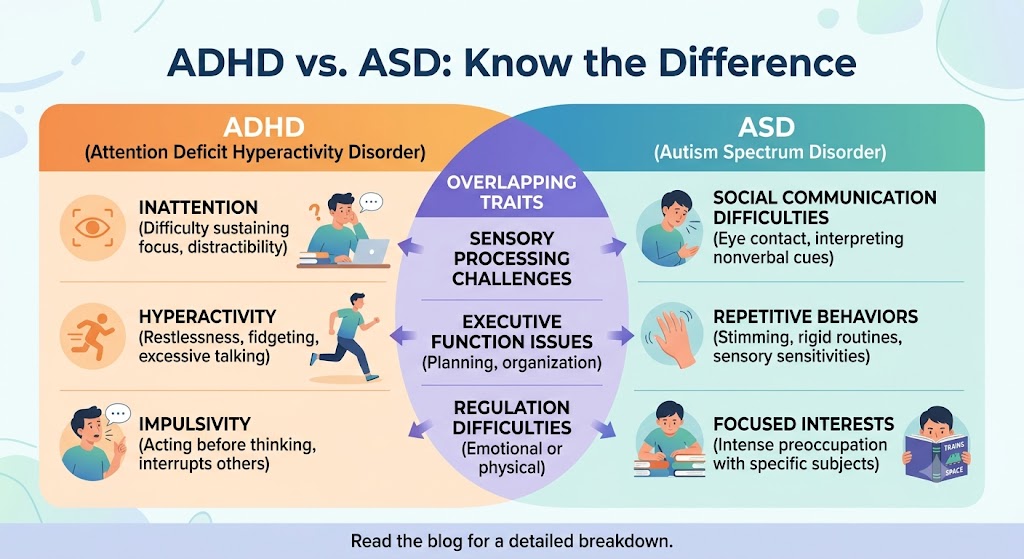
ADHD is characterized by symptoms of inattention, hyperactivity, and impulsivity. Children with ADHD may have difficulty paying attention in class, following instructions, or completing homework. They might also exhibit hyperactive behavior, such as fidgeting, restlessness, or talking excessively. Impulsive behaviors, like interrupting others or blurting out answers, are also common. In an Indian joint family setting, these behaviors can be particularly challenging to manage.
📎 Related Free Resource · Autism Spectrum
What Is ABA Therapy for Autism? A Simple & Practical Guide for ParentsABA stands for Applied Behaviour Analysis. It is an approach to understanding how behavior and learning are influenced by a perso…
📥 Download FreeTypes of ADHD
- Primarily Inattentive Type: characterized by symptoms of inattention, such as disorganization, forgetfulness, and lack of focus.
- Primarily Hyperactive-Impulsive Type: marked by symptoms of hyperactivity and impulsivity, such as restlessness, fidgeting, and interrupting others.
- Combined Type: a combination of inattentive, hyperactive, and impulsive symptoms.
Symptoms of ASD
ASD, also known as autism, is a neurodevelopmental disorder that affects communication, social interaction, and behavior. Children with ASD may have difficulty initiating or maintaining conversations, understanding social cues, or developing relationships with their peers. They might also exhibit repetitive behaviors, such as hand flapping or body rocking, and have strong interests in specific topics. In an Indian school setting, these differences can sometimes be misinterpreted as shyness or aloofness.
Autism Spectrum Disorder and Sensory Issues
Many children with ASD experience sensory processing difficulties, which can lead to overwhelm or anxiety in certain environments. For example, the loud noises and bright lights of a festival like Navratri can be overwhelming for a child with ASD. By understanding these sensory needs, parents and educators can provide accommodations to help the child feel more comfortable and secure.
Key Differences Between ADHD and ASD
While both conditions can present challenges with social interactions and behavior, there are distinct differences between ADHD and ASD. ADHD is primarily characterized by symptoms of inattention, hyperactivity, and impulsivity, whereas ASD is marked by difficulties with social communication, social interaction, and restricted or repetitive behaviors. By recognizing these differences, parents and educators can develop targeted strategies to support the child's unique needs.
Co-Occurring Conditions
It's not uncommon for children to have co-occurring conditions, such as ADHD and ASD. In these cases, a comprehensive diagnostic evaluation is essential to develop an effective support plan. By working with a multidisciplinary team of professionals, including psychologists, special educators, and therapists, parents can ensure their child receives the right interventions and accommodations.
Key Takeaways
- ADHD and ASD are distinct neurodivergent conditions with different symptoms and challenges.
- Understanding the differences between ADHD and ASD is crucial for providing targeted support and accommodations.
- Indian parents and educators can access specialized schools, centers, and government initiatives to support children with ADHD and ASD.
- Early diagnosis and intervention are critical for promoting positive outcomes and improving the quality of life for children with ADHD and ASD.
- By recognizing and embracing neurodiversity, we can create a more inclusive and supportive environment for all children to thrive.
Conclusion
As a parent or educator, it's essential to approach neurodivergent conditions like ADHD and ASD with empathy, understanding, and patience. By recognizing the distinct symptoms and challenges of these conditions, we can provide targeted support and accommodations to help children reach their full potential. Remember, every child is unique, and with the right support, they can thrive and make valuable contributions to our society. So, let's work together to create a more inclusive and supportive environment for all children, regardless of their abilities or disabilities.
Free Resources Related to This Post
ABA stands for Applied Behaviour Analysis. It is an approach to understanding how behavio…
📥 Download FreeA structured homework planner with built-in break reminders, priority boxes, and a "done!"…
📥 Download FreeHow Parents of Autistic and ADHD Children Can Overcome Stress, Financial Pressure, Stigma …
📥 Download FreePractical 2-page parent guide with warm illustrations of mom & child. Covers slow talk…
📥 Download FreeYou Might Also Find Helpful

👨👧👦 Parent Tips · 22 Sep 2026
मेरी माँ ने कैसे मेरी ऑटिज़्म से लड़ाई में मेरी मदद की: प्यार, थेरेपी और जीत की एक भावनात्मक सच्ची कहानी | सौरभमेरा नाम सौरभ है। जब मैं 9 साल का था, दु�…

👨👧👦 Parent Tips · 22 Sep 2026
How My Mom Helped Me Overcome Autism: An Emotional True Story of Love, Therapy & Triumph | Danniel LioWhen I was 9, the world felt like a puzzle missing half its pieces. I spoke differently. I behaved …

👨👧👦 Parent Tips · 06 Sep 2026
How to Manage ADHD in a 3-Year-Old at Home Without Medication: A Complete Daily Plan for ParentsPractical daily plan to manage ADHD hyperactivity in a 3-year-old at home without medication. Simple…