
Understanding Emotional Dysregulation in ADHD
Imagine your child, full of excitement and anticipation, waiting for the Ganesh Chaturthi celebrations to begin. But, as the day progresses, the crowds and noise become overwhelming, and what starts as enthusiasm quickly turns into frustration and anger. This scenario is all too familiar for many Indian parents of children with Attention Deficit Hyperactivity Disorder (ADHD). Emotional dysregulation, a common comorbidity with ADHD, can make everyday situations challenging, leaving both children and parents feeling helpless and overwhelmed.
What is Emotional Dysregulation?
Emotional dysregulation refers to the inability to manage and regulate one's emotional responses to various situations. In children with ADHD, this can manifest as intense mood swings, irritability, and explosive outbursts. These episodes can be triggered by minor setbacks, such as losing a favorite toy or being denied a treat, and can be exacerbated by the demands of a traditional Indian joint family setup, where multiple generations live together under one roof.
Causes of Emotional Dysregulation in ADHD
Research suggests that emotional dysregulation in ADHD is linked to differences in brain structure and function, particularly in regions responsible for emotional regulation, such as the prefrontal cortex and amygdala. Additionally, environmental factors, like family dynamics, school pressures, and societal expectations, can contribute to the development and maintenance of emotional dysregulation.
📎 Related Free Resource · Autism Spectrum
What Is ABA Therapy for Autism? A Simple & Practical Guide for ParentsABA stands for Applied Behaviour Analysis. It is an approach to understanding how behavior and learning are influenced by a perso…
📥 Download FreeImpact on Daily Life
The consequences of emotional dysregulation can be far-reaching, affecting not only the child's relationships with family and friends but also their academic performance. In the Indian education system, where rote learning and standardized testing are emphasized, children with ADHD and emotional dysregulation may struggle to keep up with their peers, leading to feelings of frustration and low self-esteem. Furthermore, the stigma surrounding mental health issues in India can prevent families from seeking help, exacerbating the problem.
Strategies to Help Your Child
Fortunately, there are many effective strategies to help your child manage emotional dysregulation and develop better coping mechanisms. These include:
- Creating a safe and supportive environment, where your child feels comfortable expressing their emotions
- Encouraging physical activity, such as yoga or swimming, to help regulate emotions and reduce stress
- Teaching emotional intelligence skills, such as recognizing and labeling emotions, through play-based activities or social skills groups
- Developing a daily routine that includes time for relaxation and self-care, such as reading or listening to music
- Seeking support from mental health professionals, such as therapists or counselors, who can provide individualized guidance and therapy
Government Schemes and Resources
In recent years, the Indian government has launched initiatives to support children with special needs, including the Rights of Persons with Disabilities Act, 2016, and the Samagra Shiksha Abhiyan, a scheme aimed at promoting inclusive education. Additionally, organizations like the National Centre for Promotion of Employment for Disabled People (NCPEDP) and the Disability Rights Education and Defense Fund (DREDF) provide resources and advocacy for families of children with disabilities.
Key Takeaways
- Emotional dysregulation is a common comorbidity with ADHD, characterized by intense mood swings and explosive outbursts
- Understanding the causes of emotional dysregulation, including brain differences and environmental factors, is crucial for developing effective strategies
- Creating a supportive environment, teaching emotional intelligence skills, and encouraging physical activity can help your child manage emotional dysregulation
- Seeking support from mental health professionals and taking advantage of government schemes and resources can provide additional guidance and assistance
- By working together and advocating for inclusive education and mental health support, we can empower children with ADHD and emotional dysregulation to thrive in Indian society
Conclusion
As a parent of a child with ADHD and emotional dysregulation, it's essential to remember that you're not alone. With the right support, strategies, and resources, your child can learn to manage their emotions and develop the skills they need to succeed in school and beyond. By fostering a culture of acceptance, understanding, and empathy, we can help create a more inclusive and supportive environment for all children, regardless of their abilities or challenges. So, let's work together to break down barriers and empower our children to reach their full potential, and celebrate their unique strengths and talents, just like we do during the vibrant festivals of Diwali and Holi.
Free Resources Related to This Post
ABA stands for Applied Behaviour Analysis. It is an approach to understanding how behavio…
📥 Download FreeA structured homework planner with built-in break reminders, priority boxes, and a "done!"…
📥 Download FreeHow Parents of Autistic and ADHD Children Can Overcome Stress, Financial Pressure, Stigma …
📥 Download FreePractical 2-page parent guide with warm illustrations of mom & child. Covers slow talk…
📥 Download FreeYou Might Also Find Helpful
🏫 Educator Resources · 12 Sep 2026
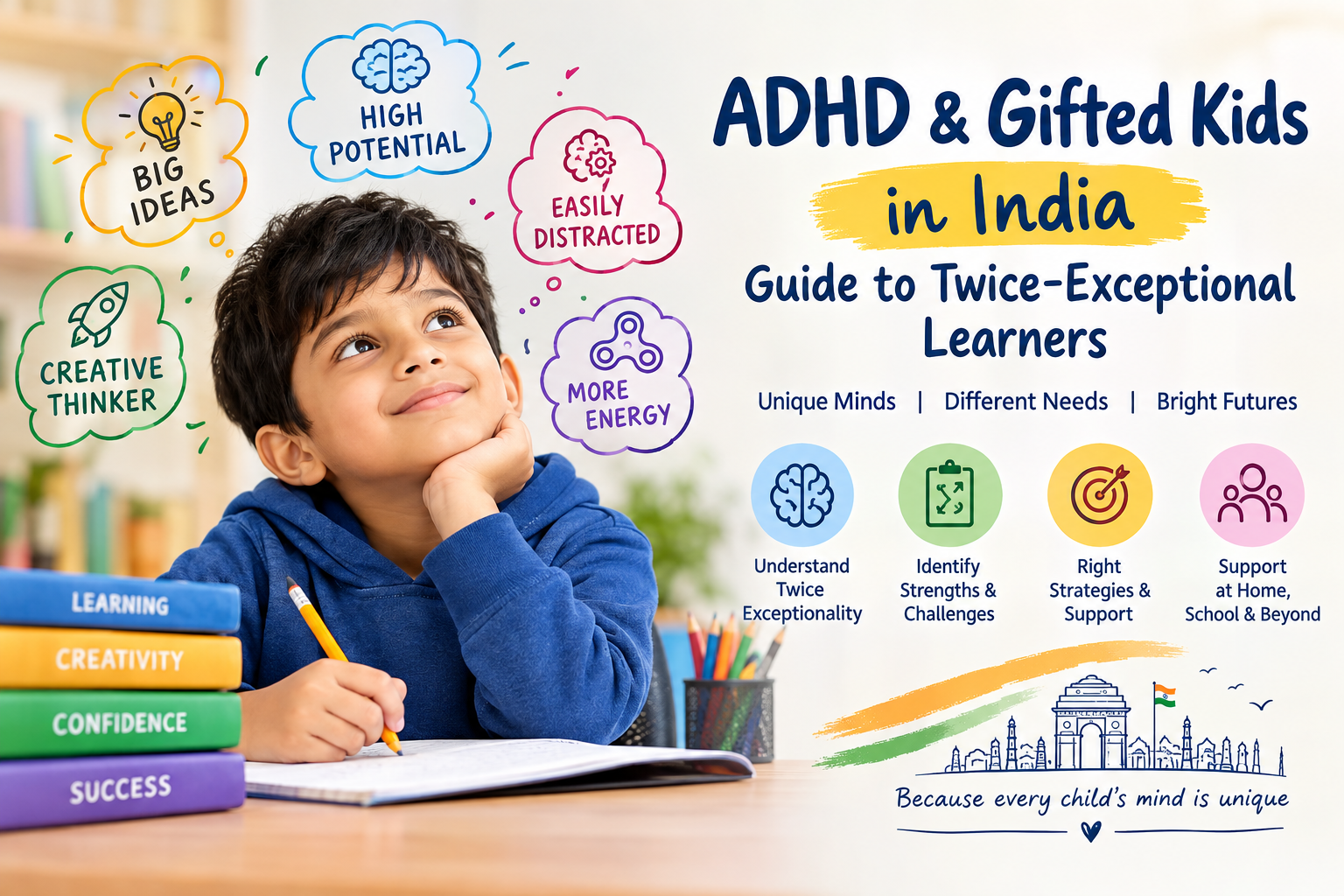
ADHD & Gifted Kids in India: Guide to Twice‑Exceptional LearnersDiscover how ADHD and giftedness can coexist in Indian children, why they are called twice‑excepti…

🏫 Educator Resources · 03 Sep 2026
Inclusive Education for Down Syndrome Children in IndiaA warm, step‑by‑step guide for Indian parents and teachers on how to create truly inclusive clas…

🏫 Educator Resources · 01 Sep 2026
Teaching a Special Child: 5 Important Rules Every Special Educator Must FollowTeaching a special child is one of the most unique tasks — there is no fixed set of rules. As a sp…