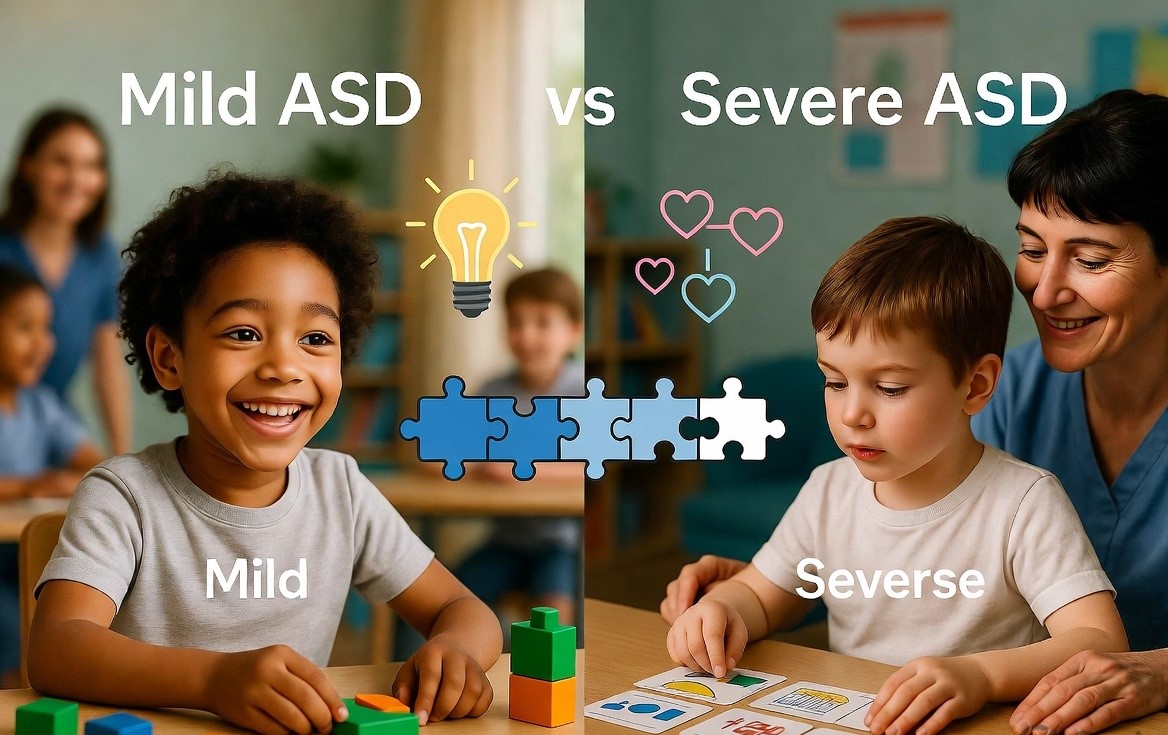
Introduction to ASD: A Parent's Journey
As a parent, watching your child grow and develop is a joyful experience. However, for many Indian parents, this journey can be filled with uncertainty and worry when their child is diagnosed with Autism Spectrum Disorder (ASD). With the increasing prevalence of ASD in India, it's essential to understand the different levels of severity and how they impact a child's life. In this blog post, we'll delve into the world of mild ASD vs severe ASD, exploring the distinct characteristics, challenges, and strategies for supporting children with these conditions.
What is ASD?
Autism Spectrum Disorder (ASD) is a neurological disorder that affects communication, social interaction, and behavior. It is a spectrum disorder, meaning that it encompasses a range of severity levels, from mild to severe. According to the Indian government's National Health Mission, approximately 1 in 100 children in India have ASD. The condition can manifest differently in each child, making it essential to understand the unique needs and challenges of your child.
Mild ASD: Characteristics and Challenges
Children with mild ASD may exhibit difficulties with social interactions, such as initiating or maintaining conversations, understanding nonverbal cues, and developing friendships. They may also struggle with flexible thinking, planning, and organization. However, children with mild ASD often have average to above-average intelligence and may excel in specific areas, such as mathematics or memory. In Indian schools, children with mild ASD may face challenges in navigating social relationships, managing sensory overload, and meeting academic expectations.
📎 Related Free Resource · Autism Spectrum
What Is ABA Therapy for Autism? A Simple & Practical Guide for ParentsABA stands for Applied Behaviour Analysis. It is an approach to understanding how behavior and learning are influenced by a perso…
📥 Download FreeSevere ASD: Characteristics and Challenges
Children with severe ASD often experience significant difficulties with verbal and nonverbal communication, social interactions, and behavior regulation. They may exhibit repetitive behaviors, such as hand flapping or body rocking, and have limited interests or activities. Children with severe ASD may also require substantial support with daily living skills, such as dressing, feeding, and toileting. In Indian joint families, where multiple generations live together, children with severe ASD may face additional challenges in managing sensory overload, navigating complex social dynamics, and accessing appropriate support services.
Supporting Children with Mild and Severe ASD in India
Regardless of the severity level, children with ASD require individualized support and accommodations to thrive. In India, parents can access various government schemes, such as the National Trust Act, which provides financial assistance and support services for children with disabilities. The Right to Education (RTE) Act also mandates inclusive education, ensuring that children with ASD have access to mainstream schools and special education services.
Strategies for Supporting Children with Mild ASD
- Developing social skills through play therapy, social stories, and role-playing
- Implementing visual schedules and checklists to enhance organization and planning
- Providing opportunities for extracurricular activities, such as sports or music, to foster social connections and interests
- Collaborating with teachers to create individualized education plans (IEPs) that address academic and social needs
Strategies for Supporting Children with Severe ASD
- Creating a structured and predictable environment to reduce anxiety and stress
- Using alternative communication methods, such as picture communication symbols or augmentative and alternative communication (AAC) devices
- Implementing behavioral interventions, such as applied behavior analysis (ABA), to address challenging behaviors
- Accessing respite care and support services to ensure the well-being of family members
Key Takeaways
- Understanding the difference between mild and severe ASD is crucial for providing individualized support and accommodations.
- Children with mild ASD may require support with social interactions, flexible thinking, and organization, while children with severe ASD may need substantial support with communication, behavior regulation, and daily living skills.
- Indian parents can access government schemes, such as the National Trust Act and the Right to Education (RTE) Act, to support their child's education and well-being.
- Collaboration between parents, teachers, and support services is essential for creating a comprehensive and inclusive support system.
- Early intervention and diagnosis can significantly impact a child's outcomes and quality of life.
Conclusion
As an Indian parent of a child with ASD, it's essential to recognize that every child is unique, and their journey with ASD is distinct. By understanding the differences between mild and severe ASD, you can better navigate the Indian education system, access support services, and create a more inclusive environment for your child. Remember, you are not alone in this journey. With the right support, accommodations, and strategies, your child can thrive and reach their full potential. So, take a deep breath, stay empowered, and celebrate your child's neurodiversity – for it is a gift that makes them uniquely special.
Free Resources Related to This Post
ABA stands for Applied Behaviour Analysis. It is an approach to understanding how behavio…
📥 Download FreePractical 2-page parent guide with warm illustrations of mom & child. Covers slow talk…
📥 Download FreeYou Might Also Find Helpful

👨👧👦 Parent Tips · 22 Sep 2026
मेरी माँ ने कैसे मेरी ऑटिज़्म से लड़ाई में मेरी मदद की: प्यार, थेरेपी और जीत की एक भावनात्मक सच्ची कहानी | सौरभमेरा नाम सौरभ है। जब मैं 9 साल का था, दु�…

👨👧👦 Parent Tips · 22 Sep 2026
How My Mom Helped Me Overcome Autism: An Emotional True Story of Love, Therapy & Triumph | Danniel LioWhen I was 9, the world felt like a puzzle missing half its pieces. I spoke differently. I behaved …
👨👧👦 Parent Tips · 06 Sep 2026
How to Manage ADHD in a 3-Year-Old at Home Without Medication: A Complete Daily Plan for ParentsPractical daily plan to manage ADHD hyperactivity in a 3-year-old at home without medication. Simple…