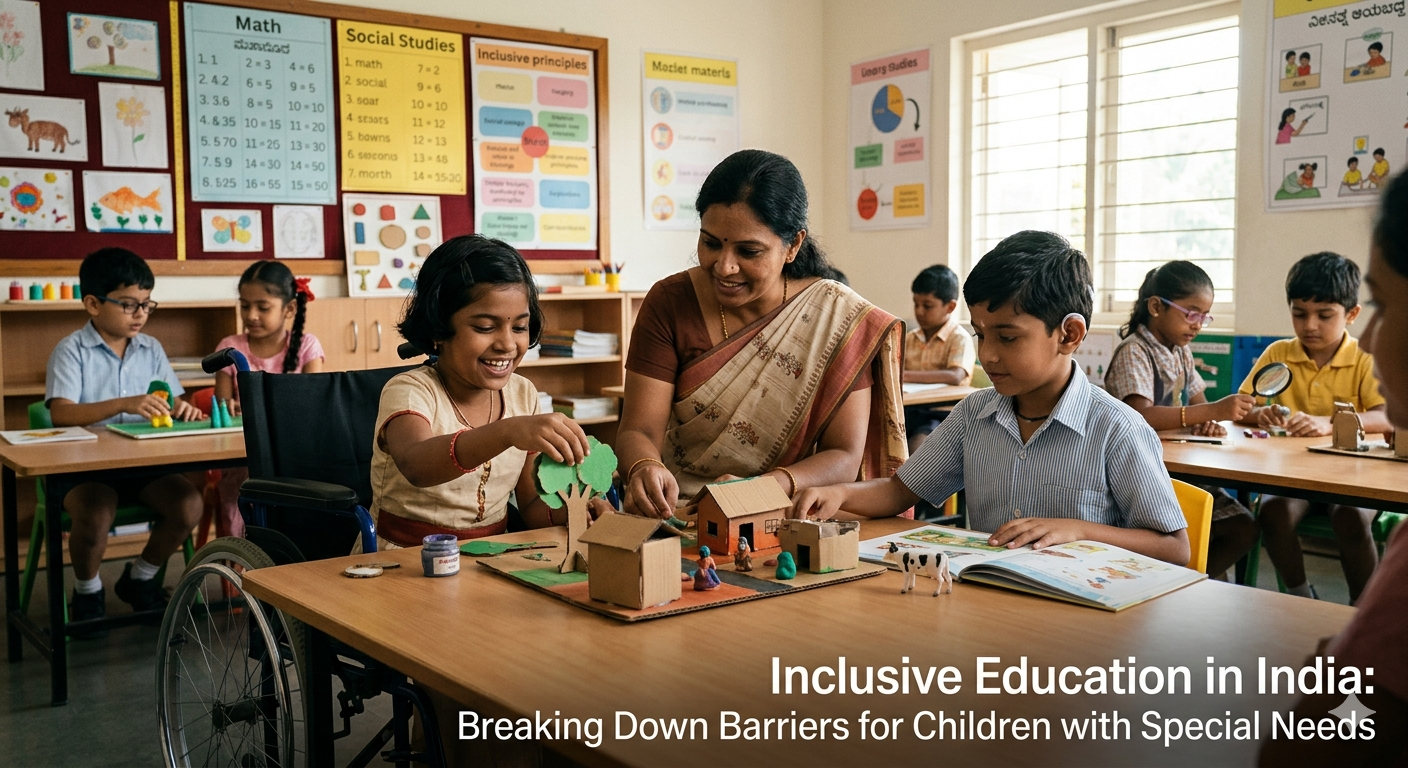
Inclusive education is an approach to teaching that values diversity and promotes the participation of all students, regardless of their abilities or disabilities. In India, where there are over 7.8 million children with special needs, inclusive education is not only a moral imperative but also a constitutional right. However, despite the progress made in recent years, many children with special needs continue to face significant barriers in accessing quality education. In this blog post, we will explore the importance of inclusive education in India, the challenges faced by children with special needs, and the strategies and resources available to support their learning.
The concept of inclusive education is rooted in the idea that all children, regardless of their abilities or disabilities, have the right to learn and participate in the educational process. Inclusive education is not just about providing access to education, but also about creating a supportive and accepting environment that values diversity and promotes social inclusion. In India, the Right to Education (RTE) Act, 2009, and the Rights of Persons with Disabilities (RPWD) Act, 2016, have laid the foundation for inclusive education by mandating that all schools provide equal opportunities to children with special needs.
Despite these legal provisions, many children with special needs in India continue to face significant challenges in accessing education. According to a report by the World Bank, children with disabilities are more likely to be out of school than their non-disabled peers, with over 40% of children with disabilities aged 5-19 not attending school. The main reasons for this include lack of accessibility, inadequate teacher training, and stigma and discrimination. Many schools in India lack the infrastructure and resources to support children with special needs, such as ramps, accessible toilets, and assistive technology. Additionally, many teachers lack the training and expertise to teach children with special needs, which can lead to a lack of confidence and low expectations.
📎 Related Free Resource · Sensory Processing
Calming Corner Visual KitPosters and visual prompts for setting up a calming corner at home or school — breathing cards, emotion thermometer, and coping …
📥 Download FreeTo address these challenges, it is essential to adopt a multi-faceted approach that involves government, schools, teachers, parents, and the community. One strategy is to provide teacher training and capacity-building programs that focus on inclusive education. This can include training on disability awareness, instructional strategies, and the use of assistive technology. Another strategy is to promote accessibility and inclusivity in school infrastructure, such as building ramps, accessible toilets, and providing assistive devices such as wheelchairs and hearing aids.
In addition to these strategies, technology can play a critical role in supporting inclusive education. Digital platforms and tools can provide children with special needs with access to a wide range of educational resources, such as e-books, educational games, and interactive simulations. Assistive technology, such as text-to-speech software and speech-to-text software, can also help children with disabilities to communicate and learn more effectively. Furthermore, online learning platforms can provide children with special needs with the flexibility to learn at their own pace and in their own environment, which can be particularly beneficial for children who may have difficulty attending traditional schools due to their disability.
Another critical aspect of inclusive education is the involvement of parents and the community. Parents of children with special needs often face significant challenges in navigating the education system and advocating for their child's rights. It is essential to provide parents with the support and resources they need to advocate for their child, such as training on disability rights, education laws, and advocacy skills. Community-based initiatives, such as parent support groups and disability organizations, can also play a vital role in promoting inclusive education and providing a platform for parents and children with special needs to share their experiences and advocate for their rights.
In conclusion, inclusive education is a critical aspect of promoting social inclusion and equality for children with special needs in India. While there are many challenges to be addressed, there are also many strategies and resources available to support the learning of children with special needs. By adopting a multi-faceted approach that involves government, schools, teachers, parents, and the community, we can create a more inclusive and supportive education system that values diversity and promotes the participation of all students. As a society, it is our responsibility to ensure that all children, regardless of their abilities or disabilities, have access to quality education and the opportunity to reach their full potential.
At SaathiLearn India, we are committed to supporting inclusive education and promoting the rights of children with special needs. We believe that every child deserves the opportunity to learn and participate in the educational process, and we are dedicated to providing the resources and support needed to make this a reality. Whether you are a parent, teacher, or educator, we invite you to join us in our mission to promote inclusive education and create a more just and equitable society for all.
Free Resources Related to This Post
Posters and visual prompts for setting up a calming corner at home or school — breathing…
📥 Download FreeABA stands for Applied Behaviour Analysis. It is an approach to understanding how behavio…
📥 Download FreePractical 2-page parent guide with warm illustrations of mom & child. Covers slow talk…
📥 Download FreeYou Might Also Find Helpful

👨👧👦 Parent Tips · 22 Sep 2026
मेरी माँ ने कैसे मेरी ऑटिज़्म से लड़ाई में मेरी मदद की: प्यार, थेरेपी और जीत की एक भावनात्मक सच्ची कहानी | सौरभमेरा नाम सौरभ है। जब मैं 9 साल का था, दु�…

👨👧👦 Parent Tips · 22 Sep 2026
How My Mom Helped Me Overcome Autism: An Emotional True Story of Love, Therapy & Triumph | Danniel LioWhen I was 9, the world felt like a puzzle missing half its pieces. I spoke differently. I behaved …
👨👧👦 Parent Tips · 06 Sep 2026
How to Manage ADHD in a 3-Year-Old at Home Without Medication: A Complete Daily Plan for ParentsPractical daily plan to manage ADHD hyperactivity in a 3-year-old at home without medication. Simple…